
Reference: http://www.graphicreflections.org/category/development/

 It was surprising to me to learn that food was being transported from one county to the other over 10,000 years ago. According to me, instead of moving away from this notion we have turned our means of getting food and its quality worse today. One would imagine that before we were to let this catastrophe happen we would have devised solutions bigger and more sustainable than the one we have today. Unfortunately, industrial Agriculture has shaped our world and multinational corporations have taken custody and control of our food system.It is true that our population is rising at a pace faster than we can sustain it. However, It is not too late for us to start making changes to the flaws that we see in our food system. For instance, I believe there are solutions better than conventional agriculture in meeting our food needs. For example, the adoption of organic farming technologies in our conventional agriculture is a great way of improving our crop yields. Next, if each and every one of us were to grow some of the most basic vegetables that we need daily, we will contribute tremendously to a healthier solution to growing our food. After all it is us, consumers that run the food market and thus public scrutiny can make a difference in the economy. By taking more into account, the distances our food travel and how it is produced, we can help reduce the higher prices of organic food and allow for its availability to those who cannot afford it.
 Vandana Shiva argues that our capitalistic paradigm today has disintegrated the biodiversity of organisms and of women. Shiva stresses that women contribution and knowledge in different fields of food production and agriculture have been underlooked. This is related to the treatment of biodiversity as a monoculture and society's patriarchic approach. Women undestand and have a large role to play in biodiversity conservation.However,biotechnology today has destroyed biodiversity whereby natural occurences of seeds are being manipulated for the benefits of multinational coorporations. Thus, patents are stealing safe and healthy food from Third World Countries by interrupting the natural flow of creation.
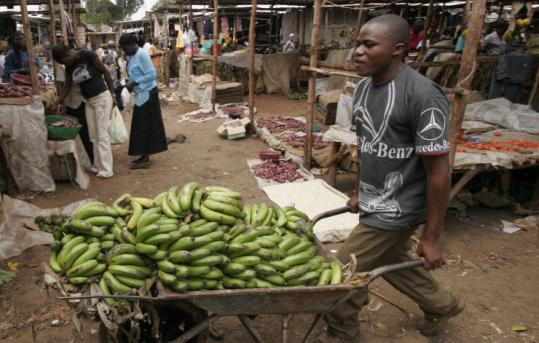 Lestor Brown stresses on the factors that will lead to food shortage which are directly related to environmental degradation. Rising grain prices will lead to an economical unsustainability making the cost of living of the million of hungry people around the world even worse. The increase in population and thus in food production have led to an unefficient usage of water and land. Land and water exploitation due to food scarcity are causing major environmental destruction along with low economic progress. Therefore, it is crucial that we find a balance between climate and population. An environmentally sustainable economy and proper use of natural resources are key to our food and population emergency.
 In this selection, Wendell Berry, emphasises on the transition of farming communities of yesterday to the community-killing agriculture of today. Science and technology has replaced traditional sustainable farming with a culturally destructive manner of agriculture. Today's culture has shifted agricultural food production from good quality to quantity. If today's culture remain disconnected as it is with nature, the healthy farming culture will slowly disintegrate and lead to a catastrophe. The agricultural system of today is switching farmers' healthy farming etiquette to money oriented agricultural etiquette.Therefore, since culture, agriculture and nature are interdependent, we need to adopt respectful measures without affecting any of the members connected in this interdependency.